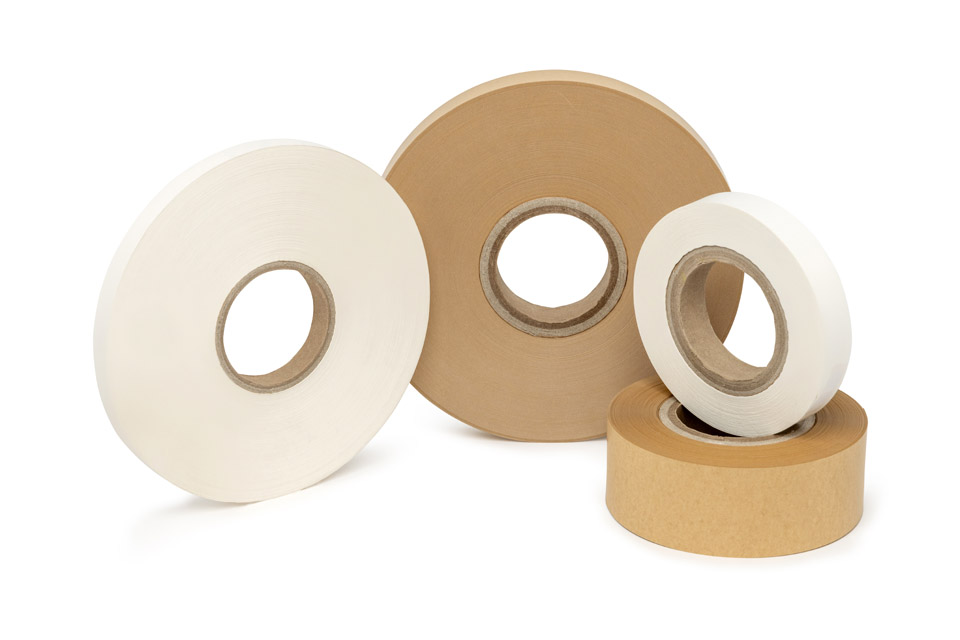


Gummed Paper for Labels, Wrappers and Bands – Applications and Selection Guide
Gummed paper is paper coated with a water-activated, plant-based adhesive: simply moisten the surface to bond a label, wrapper or band permanently to the packaging. Once dry, the adhesive forms a strong, stable joint, while the material itself remains fully paper-based – so it can be recycled together with the packaging. In this article we explain where gummed paper performs best, how gummed chalk paper differs from offset and kraft base papers, how it compares with self-adhesive labels, and how to choose the right grammage, finish and format for your process.
How does gummed paper work?
The starting point is a base paper (coated, offset or kraft) onto which we apply a plant-based adhesive, usually starch or dextrin. When dry, the adhesive layer is completely inactive: sheets and rolls can be printed, cut and stored with no risk of blocking. The adhesive is activated only when moistened with water – by hand, with a sponge or in a moistening feeder – and as the moisture evaporates, it forms a durable bond with cardboard, paper or glass.
It is worth stressing that this is not a technological novelty but a solution proven for over a century, now making a strong comeback as brands move away from plastics. Unlike self-adhesive materials, gummed paper contains no synthetic adhesives and no film components – which makes it a natural fit for companies switching to mono-material packaging that is recyclable as a whole.
Gummed paper vs self-adhesive labels – which pays off?
A self-adhesive label needs a siliconised release liner, which becomes waste immediately after application – at production scale this means hundreds of kilograms of material every month that you first pay for and then pay to dispose of. Gummed paper generates no liner waste at all: the adhesive is applied directly to the paper and activated by water. Per square metre, gummed material is usually clearly cheaper than a self-adhesive laminate of comparable area.
Self-adhesive labels keep their advantage where fast, fully automated application on existing labelling lines is essential, or where labels must stick to difficult, non-absorbent surfaces. But wherever the process allows moistening – and for wrappers, bands and seals it almost always does – gummed paper combines lower cost, a better environmental balance and an exceptionally durable bond with the substrate.
Gummed paper for labels, wrappers and bands – typical applications
Gummed paper for labels and packaging is used wherever print quality and full recyclability matter:
- Food industry – wrappers for chocolate, tea and cheese, bands for bread and confectionery, tamper-evident seals for jars and bottles. The plant-based adhesive suits the requirements of food-contact packaging, and the paper takes rich, appetising print colours.
- Cosmetics and pharma – product labels, batch markings and expiry dates, tamper bands for cartons. Variable-data printing makes batch identification straightforward.
- Textiles – garment tags, size labels, material composition markers and bands for clothing sets.
- Logistics and e-commerce – product wrapping, warehouse labelling, banding of sets and multipacks without stretch film.
- Printing and advertising – promotional print, decorative bands, stationery, closures for envelopes and gift packaging.
Gummed chalk paper or offset and kraft base?
Gummed chalk paper (coated paper with an adhesive layer) is the premium choice: its smooth, white surface in semi-gloss or gloss finish delivers excellent colour reproduction and crisp detail in offset, flexographic and digital printing. It is the standard for premium food wrappers, cosmetics labels and decorative bands.
The offset base is chosen for universal applications – where print must be clear and durable but no gloss effect is required. Kraft paper, in turn, works best where mechanical strength or a natural, ecological packaging look matters most – its raw texture communicates a sustainable choice all by itself. In practice, many customers combine substrates within one product line: gummed chalk paper for the front label and kraft for the band or seal.
Gummed paper vs gummed tape – what is the difference?
The same technology is behind gummed tape, also known as water-activated paper tape – a narrow roll of kraft paper with starch adhesive, used for sealing cartons. The difference lies mainly in purpose and converting: gummed paper goes into printed labels, wrappers and bands (sheets or wider rolls), while gummed tape works in packing rooms as an eco-friendly carton closure with a tamper-evident seal effect. If carton sealing is what you need, you will find the details on our paper tapes page.
Technical parameters of DOLPAP gummed paper
| Parameter | Range |
| Paper type | coated (gummed chalk paper), offset, kraft |
| Grammage | 98 gsm and 108 gsm (others on request) |
| Colour | white |
| Finish | semi-gloss, gloss |
| Adhesive | plant-based, water-activated |
| Converting | rolls 15–1000 mm, sheets cut to size |
| Printing | offset, flexo, digital |
Printing and converting: roll or sheet?
Gummed paper takes offset, flexographic and digital printing very well – from full-colour artwork to variable data such as batch numbers and expiry dates. The material can be cut, die-cut and perforated, giving full freedom in designing the shape of a label or band.
The choice of format depends on how you apply it. Rolls (15 to 1000 mm wide) are chosen for machine application – on banding and labelling machines – and for high volumes. Sheets cut to size work best for offset and digital printing and for manual application at smaller scale. We also advise on winding direction and core diameters to match the customer’s specific machines.
Storage and handling of gummed paper
Because the adhesive is activated by water, the material should be stored in a dry room at stable relative humidity, away from moisture sources – kept this way, it retains its full properties for a long time. During application, even moistening is the key: too little water weakens the bond, too much extends the setting time. At larger scale it is worth using moistening feeders, which dose water automatically and keep the process repeatable. Our technologists help set the application parameters at the start of cooperation.
Sustainability: gummed paper and the PPWR
The EU Packaging and Packaging Waste Regulation (PPWR) puts recyclable packaging and plastic reduction at the centre. Gummed paper fits these requirements perfectly: the plant-based adhesive does not contaminate the paper recycling stream, and a label, wrapper or band is recycled together with the paper packaging – no separation needed. For purchasing and sustainability teams this means simpler environmental documentation and a genuine argument in brand communication. Replacing self-adhesive laminates with gummed paper is one of the easiest packaging changes to implement – it requires no redesign of the packaging itself, only a change of material and application method.
How to choose the right gummed paper for your process
A few questions will guide the selection. What are you labelling and on which surface – cardboard, glass or wrapping paper? Which printing technique will be used, and does the artwork require a coated surface? Is application manual or on a machine (this determines the format: roll or sheet)? How much strength do you need – for heavier wrappers and bands we recommend the higher 108 gsm grammage, while 98 gsm is enough for light labels. Our technologists help match the material to your process based on samples and tests in our in-house laboratory – just describe your process and print requirements.
Why DOLPAP?
We are a family-owned company from Chojnów, Poland, with paper-converting experience dating back to the 1950s. We run our own R&D centre, established in cooperation with the Wrocław University of Science and Technology, an in-house laboratory, and we hold ISO 9001:2015 and ISO 45001:2018 certificates. We produce and convert gummed paper to order – from narrow rolls to custom-size sheets – and every batch can be laboratory-tested for the parameters critical to the customer’s process. Add to that flexible order volumes and technical advice at every stage of cooperation.
FAQ – gummed paper
Is gummed paper recyclable?
Yes. The plant-based adhesive contains no plastics, so a label or band can be recycled together with the paper packaging, with no separation of fractions.
How does gummed paper differ from a self-adhesive label?
A self-adhesive label needs a siliconised release liner, which becomes waste. Gummed paper generates no liner waste and costs less per square metre.
Is gummed chalk paper suitable for digital printing?
Yes, the coated surface performs very well in digital, offset and flexographic printing – including variable-data jobs.
Which formats is gummed paper available in?
In rolls from 15 to 1000 mm wide and in sheets cut to size, with winding and core options matched to the customer’s machine.
How should gummed paper be stored?
In a dry room at stable humidity, in its original packaging. Protected this way, the material retains its full adhesive properties for a long time.
Does DOLPAP print on gummed paper?
Yes – we offer printing as well as cutting and converting as in-house services, so the whole process can stay with a single supplier.
Is gummed paper suitable for food packaging?
The plant-based, water-activated adhesive fits the requirements of food-industry packaging – gummed paper has been used for decades for wrappers, bands and seals on food products. For specific applications we can confirm the parameters with laboratory tests.
Need samples or help with selection? Contact us – we will recommend the grammage, finish and format best suited to your process and send samples for testing.