
Paper Tape or Plastic Tape? Comparing Cost, Recycling and Shipment Security
Paper tape or plastic tape – which works better for your packing line? The short answer: water-activated paper tape wins on recyclability, tamper evidence and brand image, while plastic tape remains cheaper to buy per metre. But once you calculate the total cost – tape consumption, waste sorting at the recipient’s end, losses from opened shipments – the balance often tips in favour of paper. Below we compare both solutions point by point: from the bonding mechanism, through costs and regulations, to the ergonomics of the packer’s daily work.
How does paper tape differ from plastic tape?
Eco-friendly packing tape is based on kraft paper (82 or 92 gsm) coated with a natural, water-activated starch adhesive. It is applied with a dispenser that moistens the adhesive just before sealing. Plastic tape (PP or PVC) relies on synthetic adhesives – acrylic, rubber or hot-melt – and is applied by hand or with a tape gun.
The difference lies in both the material and the bonding mechanism: water-activated adhesive penetrates the carton fibres and bonds with the board permanently, instead of merely sticking to the surface. In practice this means the closure becomes an integral part of the carton – resistant to temperature swings, dust and adhesive ageing, which can weaken self-adhesive tapes during longer storage or transport.
Cost: price per metre is not the whole story
A metre of plastic tape is usually cheaper than paper tape, and on that single comparison it wins. In practice, however, several factors close the gap – and they only become visible at the scale of the whole packing operation.
First, consumption: one strip of water-activated tape is normally enough to seal a carton, whereas PP tape is often applied in two or three layers “just in case” – so the real usage per parcel can be two to three times higher, and the cost with it. Second, claims: the permanent bond with the carton reduces cases of boxes popping open in transit, and every damaged shipment means the cost of reshipping and claim handling. Third, waste: a carton sealed with paper tape needs no separation before recycling, which lowers waste-handling costs for both the sender and the recipient. At high volumes it simply pays to calculate the cost of closing one parcel (tape + labour time + claims) rather than the price of a roll – we are happy to help with such a calculation based on data from your packing room.
Is paper tape recyclable?
Yes – and this is its biggest advantage. Water-activated paper tape is fully biodegradable and goes into recycling together with the cardboard box, with no peeling or sorting required. The starch adhesive dissolves during paper reprocessing and does not contaminate the fibre pulp. Plastic tape should formally be separated from the board, which most recipients never do – so the film ends up in the paper stream as a contaminant and lowers the quality of the recyclate.
There is also a regulatory dimension. The EU Packaging and Packaging Waste Regulation (PPWR) prioritises recyclable packaging and will progressively tighten requirements for every company placing packaging on the market. The “carton + paper tape” combination is the simplest route to compliance: the entire package forms a single material stream. For companies reporting ESG goals it is also a concrete, measurable argument – the elimination of plastic from every parcel shipped.
Shipment security: the seal effect
Starch adhesive bonds with the carton surface so strongly that any attempt to remove the tape destroys the top layer of the board. An opened parcel cannot be resealed without leaving visible traces – the so-called seal effect, which PP tapes do not provide: a self-adhesive tape can be carefully peeled off and reapplied without leaving obvious marks. For e-commerce and logistics, the seal effect means less pilferage in transit, easier resolution of claim disputes and a clear signal to the customer that the parcel arrived intact.
Strength: standard and reinforced versions
Standard paper tape made of 82 or 92 gsm kraft easily seals typical e-commerce cartons. For heavy cartons and oversized shipments we recommend tapes reinforced with fibres or mesh – the load-bearing insert carries greater loads than standard plastic tapes, so even cartons weighing tens of kilograms stay securely closed with a single strip of tape. This answers a common myth that paper tape is “too weak” for industrial applications.
Brand image and printing
Paper tape with custom printing (logo, sustainability message, warning signs, batch numbers) turns every parcel into a brand carrier and highlights your company’s environmental commitment – in line with what e-commerce customers expect, as they pay more and more attention to how their order arrives. The natural, matt texture of kraft displays print beautifully and makes a shipment stand out against standard film closures. Printing on plastic tape is possible too, but the result remains plastic waste – an ecological message printed on film loses credibility.
Application and ergonomics: manual or automatic dispenser?
Water-activated tape requires a moistening dispenser – and this is often the main concern when switching. In practice, a manual dispenser feeds strips of a preset length, evenly moistened, which speeds up work compared with tearing and trimming tape from a tape gun – and eliminates the loud noise of unwinding film in the process. Automatic and electric dispensers feed tape in series, with programmable strip lengths, and integrate with packing lines at high volumes. The choice of device depends on the number of parcels per shift – we advise on the right model as part of cooperation and help train the packing team. After a short adjustment period, most packing teams report that working with a dispenser is faster and quieter than with a tape gun.
When does plastic tape still make sense?
A fair comparison should name the cases where plastic holds its ground: packing in very high humidity, cold-store and freezer warehouses, cartons with heavily coated, slippery surfaces, or sealing packaging other than cardboard. In such cases a synthetic adhesive can be the safer bet. In all other applications – from standard e-commerce dispatch, through industry, to archiving – paper tape delivers the full set of benefits without compromise.
Comparison: paper tape vs plastic tape
| Criterion | Paper tape (WAT) | Plastic tape (PP/PVC) |
| Material | kraft paper 82/92 gsm | PP or PVC film |
| Adhesive | starch, water-activated | acrylic / rubber / hot-melt |
| Recycling | with the carton, no sorting | must be separated |
| Seal effect | yes | no |
| Price per metre | higher | lower |
| Total cost | often lower (1 strip per carton) | depends on usage (2–3 strips) |
| Printing | yes, with an “eco” image | yes |
| Application | manual/automatic dispenser | by hand / tape gun |
| PPWR compliance | full (single material stream) | requires separation |
How to switch to paper tape: an implementation plan
The change does not require a revolution in your packing room. Four steps are enough in practice. First, sample tests on your own cartons – we check adhesion on your specific board and select the grammage and width (standard 50, 60 or 70 mm). Next, matching a dispenser to your shipping volume and training the team, which literally takes a few minutes. Then a pilot on part of your shipments, comparing tape usage and packing time with the current process. Finally, full roll-out – optionally with custom-printed tape, whose design can be prepared in parallel. The whole cycle, from first samples to regular deliveries, typically closes within a few weeks.
Why DOLPAP?
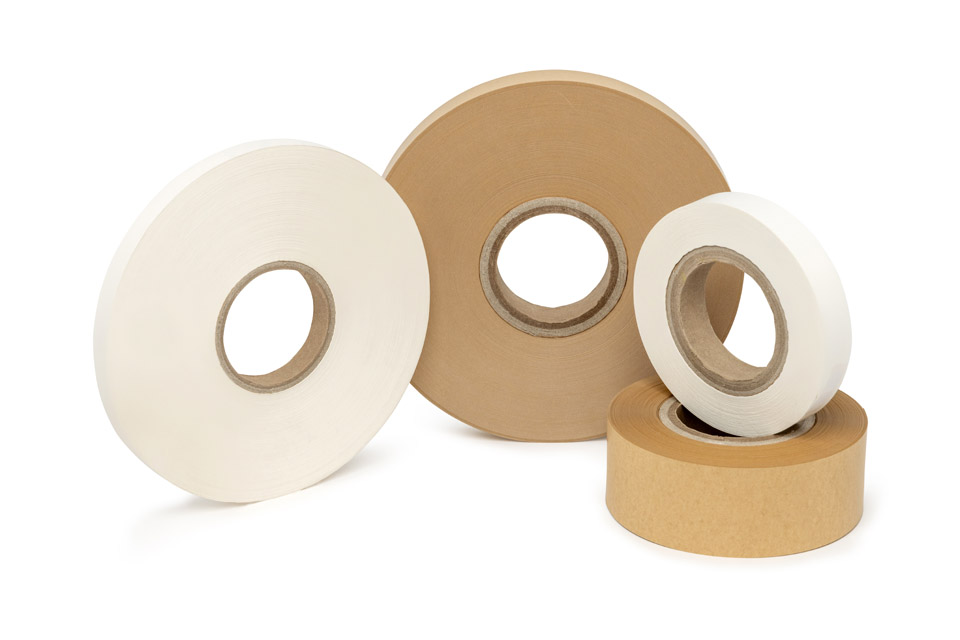
We manufacture paper tapes in Poland – in rolls from 15 to 1000 mm (standard 50, 60 and 70 mm), in white and brown, in standard and reinforced versions, with custom printing available. We advise on grammage and dispenser selection, prepare samples for testing on the customer’s cartons, and back our quality with tests in our in-house laboratory and with ISO 9001:2015 and ISO 45001:2018 certificates. As a manufacturer, we also offer short lead times and flexible order volumes – from pilot runs to regular deliveries.
FAQ – paper tape or plastic tape
Is paper tape strong enough for heavy parcels?
Yes – versions reinforced with glass fibre or mesh carry loads greater than standard PP tapes and perform well with oversized shipments.
Does switching to paper tape require new equipment?
You need a moistening dispenser – manual or automatic. We will match the model to your packing volume, and team training takes just a few minutes.
Does water-activated tape bond with every carton?
It bonds best with board that has a natural, absorbent surface; for heavily coated cartons we recommend a sample test before roll-out.
Can paper tape be used on automated packing lines?
Yes. Automatic dispensers feed pre-cut tape lengths and integrate with packing lines, speeding up work at high shipping volumes.
Is paper tape more expensive in daily use?
Usually not. One strip of WAT tape replaces two or three strips of PP tape, and savings on claims and waste handling come on top – the cost of closing a parcel often ends up lower.
Can a company logo be printed on paper tape?
Yes – we offer custom printing of logos, sustainability messages and warning signs, so the tape also works as a marketing tool.
How should water-activated tape be stored?
In a dry room at stable humidity, in its original packaging. Stored this way, the tape retains its full adhesive properties for a long time – the starch adhesive stays inactive until it is moistened.
Want to compare both solutions in practice? Contact us – we will prepare paper tape samples, help you choose a dispenser and calculate the total cost for your packing line.